Business
The rags to riches tale of a larger-than-life romance of over seven decades
Me and Issy is a love story about how a troubled and deprived child chanced to meet a man who worshipped her, brought her a fantasy life of four boys and extraordinary opulence — and banished her self-doubt. She in her turn was awestruck and mystified by his acumen and daring during his founding of the Four Seasons Hotels.
Beginning with her childhood in North Toronto, in a very Jewish home surrounded by non-Jews, Rosalie enchants us with anecdotes about her family, Isadore Sharp’s family, and the growth of their own in the light of the expanding Four Seasons chain. How did she go to the Ontario College of Art & Design while simultaneously raising four rambunctious boys? How did Issy open hotel after hotel with only his collateral of confidence and charisma? Rosalie is a rapt follower of his astonishing success and the first fan of his legendary town hall talks to 40,000 employees.
And with success came tragedy. The devastating death of their son Chris shook them, but they coped. Here, all of Rosalie’s life is opened up for viewing, the good and the bad, the success and the failures, but especially her inspired romance with Issy. In the words of their second eldest son, Greg, “Their mutual love and respect growing stronger over the past 69 years is as extraordinary as it is beautiful.”

"The 38 Letters from J.D. Rockefeller to His Son" offers an intimate and profound glimpse into the extraordinary mind and life of one of history's most influential figures, John D. Rockefeller, as he imparts his perspectives, ideology, and timeless wisdom to his beloved son.
Spanning a period of several decades, this captivating collection of letters showcases the correspondence between John D. Rockefeller, the renowned American business magnate, philanthropist, and visionary, and his son, John D. Rockefeller Jr. Through these heartfelt and thought-provoking letters, we witness the unfolding of a unique father-son relationship, guided by Rockefeller Sr.'s desire to instill in his heir a sense of purpose, integrity, and responsibility.
In these intimate exchanges, J.D. Rockefeller Sr. shares his personal experiences, successes, and failures, revealing the principles and values that shaped his incredible journey in the worlds of business, philanthropy, and social change. From his pioneering efforts in the oil industry to his philanthropic endeavors that transformed education, medicine, and scientific research, Rockefeller Sr. provides valuable insights and practical advice on leadership, wealth, ethics, and the pursuit of a meaningful life.
Each letter within this remarkable collection is accompanied by insightful commentary and analysis, providing readers with historical context and highlighting the profound impact of Rockefeller Sr.'s words on his son's life and the broader world. These letters not only offer a unique perspective on the Rockefeller family legacy but also serve as a timeless guide for individuals seeking guidance in navigating the complexities of personal and professional life.
"The 38 Letters from J.D. Rockefeller to His Son" is an illuminating and deeply moving exploration of the principles, ideologies, and wisdom that propelled one of the most influential families in American history. It serves as an inspiring testament to the enduring power of a father's love, mentorship, and the timeless wisdom that can shape the lives of generations to come.
From his early years in the storied arbitrage department at Goldman Sachs to his current position as chairman of the executive committee of Citigroup, Robert Rubin has been a major figure at the center of the American financial system. He was a key player in the longest economic expansion in U.S. history. With In an Uncertain World, Rubin offers a shrewd, keen analysis of some of the most important events in recent American history and presents a clear, consistent approach to thinking about markets and dealing with the new risks of the global economy.
Rubin's fundamental philosophy is that nothing is provably certain. Probabilistic thinking has guided his career in both business and government. We see that discipline at work in meetings with President Clinton and Hillary Clinton, Chinese premier Zhu Rongji, Alan Greenspan, Lawrence Summers, Newt Gingrich, Sanford Weill, and the late Daniel Patrick Moynihan. We see Rubin apply it time and again while facing financial crises in Asia, Russia, and Brazil; the federal government shutdown; the rise and fall of the stock market; the challenges of the post-September 11 world; the ongoing struggle over fiscal policy; and many other momentous economic and political events.
With a compelling and candid voice and a sharp eye for detail, Rubin portrays the daily life of the White House-confronting matters both mighty and mundane--as astutely as he examines the challenges that lie ahead for the nation. Part political memoir, part prescriptive economic analysis, and part personal look at business problems, In an Uncertain World is a deep examination of Washington and Wall Street by a figure who for three decades has been at the center of both worlds.
Nominated as one of America’s best-loved novels by PBS’s The Great American Read
The Sirens of Titan is an outrageous romp through space, time, and morality. The richest, most depraved man on Earth, Malachi Constant, is offered a chance to take a space journey to distant worlds with a beautiful woman at his side. Of course there’ s a catch to the invitation–and a prophetic vision about the purpose of human life that only Vonnegut has the courage to tell.
“Reading Vonnegut is addictive!”—Commonweal

Wall Street Journal, USA Today, and Publishers Weekly Bestseller
The secret to leading growth is your mindset
Snowflake CEO Frank Slootman is one of the tech world's most accomplished executives in enterprise growth, having led Snowflake to the largest software IPO ever after leading ServiceNow and Data Domain to exponential growth and the public market before that. In Amp It Up: Leading for Hypergrowth by Raising Expectations, Increasing Urgency, and Elevating Intensity, he shares his leadership approach for the first time.
Amp It Up delivers an authoritative look at what it takes to transform an organization for maximum growth and scale. Slootman shows that most leaders have significant room to improve their organization's performance without making expensive changes to their talent, structure, or fundamental business model—and they don’t need to bring in an army of consultants to do it. What they do need is to align people around what matters and execute with urgency and intensity every day.
Leading for unprecedented growth means declaring war on mediocrity, breaking the status quo, and making conflicted choices daily, all with a relentless focus on the mission. Amp It Up provides the first principles to guide that change, and the tactical advice for organizing a company around them.
Perfect for executives, entrepreneurs, founders, managers, and leaders of all kinds, Amp It Up is a must-read resource for anyone who seeks to unleash the growth potential of a company and scale it to heights they never thought possible.
Build an iconic shopping experience that your customers love—and a work environment that your employees love being a part of—using this blueprint from Trader Joe’s visionary founder, Joe Coulombe.
Infuse your organization with a distinct personality and culture that draws customers in a way that simply competing on price cannot.
Joe Coulombe founded what would become Trader Joe’s in the late 1960s and helped shape it into the beloved, quirky food chain it is today. Realizing early on that he could not compete and win by playing the same game his bigger competitors were playing, he decided to build a store for educated people of somewhat modest means. He brought in unusual products from around the world and promoted them in the Fearless Flyer, providing customers with background on how they were sourced and their nutritional value. He also gave the stores a tiki theme to reinforce the exotic trader ship concept with employees wearing Hawaiian shirts.
In this way, Joe laid down a blueprint for other business owners to follow to build their own unique shopping experience that customers love, and a work environment that employees love being a part of.
In Becoming Trader Joe, Joe shares the lessons he learned by challenging the status quo and rethinking the way a business operates. He shows readers of all types:
- How moving from a pure analytical approach to a more creative, problem-solving approach can drive innovation.
- How finding an affluent niche of passionate customers can be a better strategy than competing on price and volume.
- How questioning all aspects of the way you do business leads to powerful results.
- How to build a business around your values and identity.
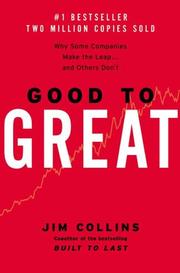
The Challenge
Built to Last, the defining management study of the nineties, showed how great companies triumph over time and how long-term sustained performance can be engineered into the DNA of an enterprise from the verybeginning.
But what about the company that is not born with great DNA? How can good companies, mediocre companies, even bad companies achieve enduring greatness?
The Study
For years, this question preyed on the mind of Jim Collins. Are there companies that defy gravity and convert long-term mediocrity or worse into long-term superiority? And if so, what are the universal distinguishing characteristics that cause a company to go from good to great?
The Standards
Using tough benchmarks, Collins and his research team identified a set of elite companies that made the leap to great results and sustained those results for at least fifteen years. How great? After the leap, the good-to-great companies generated cumulative stock returns that beat the general stock market by an average of seven times in fifteen years, better than twice the results delivered by a composite index of the world's greatest companies, including Coca-Cola, Intel, General Electric, and Merck.
The Comparisons
The research team contrasted the good-to-great companies with a carefully selected set of comparison companies that failed to make the leap from good to great. What was different? Why did one set of companies become truly great performers while the other set remained only good?
Over five years, the team analyzed the histories of all twenty-eight companies in the study. After sifting through mountains of data and thousands of pages of interviews, Collins and his crew discovered the key determinants of greatness -- why some companies make the leap and others don't.
The Findings
The findings of the Good to Great study will surprise many readers and shed light on virtually every area of management strategy and practice. The findings include:
- Level 5 Leaders: The research team was shocked to discover the type of leadership required to achieve greatness.
- The Hedgehog Concept (Simplicity within the Three Circles): To go from good to great requires transcending the curse of competence.
- A Culture of Discipline: When you combine a culture of discipline with an ethic of entrepreneurship, you get the magical alchemy of great results. Technology Accelerators: Good-to-great companies think differently about the role of technology.
- The Flywheel and the Doom Loop: Those who launch radical change programs and wrenching restructurings will almost certainly fail to make the leap.
“Some of the key concepts discerned in the study,” comments Jim Collins, "fly in the face of our modern business culture and will, quite frankly, upset some people.”
Perhaps, but who can afford to ignore these findings?
The path to your professional success starts with a critical look in the mirror.
If you read nothing else on managing yourself, read these 10 articles (plus the bonus article "How Will You Measure Your Life?" by Clayton M. Christensen). We've combed through hundreds of Harvard Business Review articles to select the most important ones to help you maximize yourself.
HBR's 10 Must Reads on Managing Yourself will inspire you to:
- Stay engaged throughout your 50+-year work life
- Tap into your deepest values
- Solicit candid feedback
- Replenish physical and mental energy
- Balance work, home, community, and self
- Spread positive energy throughout your organization
- Rebound from tough times
- Decrease distractibility and frenzy
- Delegate and develop employees' initiative

Do you have a burning passion to make a lot of money in business? Are you ready to turbocharge your chances of professional and personal success?
During his more than four decades as a CEO and serial entrepreneur, Brad Jacobs has created eight flagship companies across different industries, delivering tens of billions of dollars of value to shareholders. In How to Make a Few Billion Dollars, Jacobs defines the mindset that drives his remarkable success in corporate America—and distills a lifetime of business brilliance into a tactical road map.
From provocative recommendations for “rearranging your brain”—an essential prerequisite to accomplishing enormous goals—to practical advice for dealing with colleagues, Jacobs will have you rethinking what it means to win big. He explains why it’s critical to spot key trends and capitalize on them, including the biggest trend of all—the rapid evolution of technology relative to human development. And, he shares his techniques for:
• turning a healthy fear of failure to your advantage,
• achieving lots of high-quality M&A without imploding,
• building an outrageously talented team,
• catalyzing electric meetings, and
• transforming a company into a superorganism that kills the competition.
How to Make a Few Billion Dollars is an inside look at how this entrepreneurial titan leads with humility, compassion, and accountability, while running hard toward the American Dream. If your personal dream is to create wealth through free markets or to triumph in sports, the arts, politics, philanthropy, or any other part of your life, this book will help you make that a reality.

My Life in Advertising is written by Claude C. Hopkins. He was the widely known as the father of Advertising. This is his autobiography. He shared his experiences in advertising industry.
Never try to show off. You are selling your product, not yourself. Do nothing to cloud your objective. Use the shortest words possible. Let every phrase ring with sincerity.
From start to finish offer service. That is what you selling, that is all your prospect wants. Weigh every sentence on that basis. Waste no space, no money to any other end. I have seen many an ad. killed by a single unfortunate phrase. Usually a selfish phrase, indicating ulterior desires which repel. Phrases like "Insist on this brand," "Avoid imitations," "Look out for substitution." Such appeals have no good effect, and they indicate a motive with which buyers cannot sympathize.
Alfred P. Sloan, Jr. led the General Motors Corporation to international business success by virtue of his brilliant managerial practices and his insights into the new consumer economy he and General Motors helped to produce. Sloan's business biography, My Years With General Motors, was an instant best seller when it was first published in 1964 and is still considered indispensable reading by modern business giants.
The bestselling business book from award-winning restauranteur Danny Meyer, of Union Square Cafe, Gramercy Tavern, and Shake Shack
Seventy-five percent of all new restaurant ventures fail, and of those that do stick around, only a few become icons. Danny Meyer started Union Square Cafe when he was 27, with a good idea and hopeful investors. He is now the co-owner of a restaurant empire. How did he do it? How did he beat the odds in one of the toughest trades around? In this landmark book, Danny shares the lessons he learned developing the dynamic philosophy he calls Enlightened Hospitality. The tenets of that philosophy, which emphasize strong in-house relationships as well as customer satisfaction, are applicable to anyone who works in any business. Whether you are a manager, an executive, or a waiter, Danny’s story and philosophy will help you become more effective and productive, while deepening your understanding and appreciation of a job well done.
Setting the Table is landmark a motivational work from one of our era’s most gifted and insightful business leaders.
A companion guidebook to the number-one bestselling Good to Great, focused on implementation of the flywheel concept, one of Jim Collins’ most memorable ideas that has been used across industries and the social sectors, and with startups.
The key to business success is not a single innovation or one plan. It is the act of turning the flywheel, slowly gaining momentum and eventually reaching a breakthrough. Building upon the flywheel concept introduced in his groundbreaking classic Good to Great, Jim Collins teaches readers how to create their own flywheel, how to accelerate the flywheel’s momentum, and how to stay on the flywheel in shifting markets and during times of turbulence.
Combining research from his Good to Great labs and case studies from organizations like Amazon, Vanguard, and the Cleveland Clinic which have turned their flywheels with outstanding results, Collins demonstrates that successful organizations can disrupt the world around them—and reach unprecedented success—by employing the flywheel concept.
“A must-read that hopefully will be adapted for the screen. Greene lets Wilzig’s effervescent spirit shine through, and his story will appeal to a wide variety of readers.” - Library Journal
Unstoppable is the ultimate immigrant story and an epic David-and-Goliath adventure. While American teens were socializing in ice cream parlors, Siggi was suffering beatings by Nazi hoodlums for being a Jew and was soon deported along with his family to the darkest place the world has ever known: Auschwitz. Siggi used his wits to stay alive, pretending to have trade skills the Nazis could exploit to run the camp. After two death marches and near starvation, he was liberated from camp Mauthausen and went to work for the US Army hunting Nazis, a service that earned him a visa to America. On arrival, he made three vows: to never go hungry again, to support the Jewish people, and to speak out against injustice. He earned his first dollar shoveling snow after a fierce blizzard. His next job was laboring in toxic sweatshops. From these humble beginnings, he became President, Chairman and CEO of a New York Stock Exchange-listed oil company and grew a full-service commercial bank to more than $4 billion in assets.
Siggi’s ascent from the darkest of yesterdays to the brightest of tomorrows holds sway over the imagination in this riveting narrative of grit, cunning, luck, and the determination to live life to the fullest.
Under Andy Grove's leadership, Intel became the world's largest chip maker and one of the most admired companies in the world. In Only the Paranoid Survive, Grove reveals his strategy for measuring the nightmare moment every leader dreads--when massive change occurs and a company must, virtually overnight, adapt or fall by the wayside--in a new way.
Grove calls such a moment a Strategic Inflection Point, which can be set off by almost anything: mega-competition, a change in regulations, or a seemingly modest change in technology. When a Strategic Inflection Point hits, the ordinary rules of business go out the window. Yet, managed right, a Strategic Inflection Point can be an opportunity to win in the marketplace and emerge stronger than ever.
Grove underscores his message by examining his own record of success and failure, including how he navigated the events of the Pentium flaw, which threatened Intel's reputation in 1994, and how he has dealt with the explosions in growth of the Internet. The work of a lifetime, Only the Paranoid Survive is a classic of managerial and leadership skills.

The success of Starbucks Coffee Company is one of the most amazing business stories in decades. What started as a single store on Seattle’s waterfront has grown into a company with over sixteen hundred stores worldwide and a new one opening every single business day. Just as remarkable as this incredible growth is the fact that Starbucks has managed to maintain its renowned commitment to product excellence and employee satisfaction.
In Pour Your Heart Into It, CEO Howard Schultz illustrates the principles that have shaped the Starbucks phenomenon, sharing the wisdom he has gained from his quest to make great coffee part of the American experience. Marketers, managers, and aspiring entrepreneurs will discover how to turn passion into profit in this definitive chronicle of the company that “has changed everything . . . from our tastes to our language to the face of Main Street.” (Fortune)