Genius Quest
10 books
Genius
☰
"Surely You're Joking, Mr. Feynman!": Adventures of a Curious Character
A New York Times bestseller—the outrageous exploits of one of this century's greatest scientific minds and a legendary American original. Richard Feynman, winner of the Nobel Prize in physics, thrived on outrageous adventures. Here he recounts in his inimitable voice his experience trading ideas on atomic physics with Einstein and Bohr and ideas on gambling with Nick the Greek; cracking the uncrackable safes guarding the most deeply held nuclear secrets; accompanying a ballet on his bongo drums; painting a naked female toreador. In short, here is Feynman's life in all its eccentric—a combustible mixture of high intelligence, unlimited curiosity, and raging chutzpah.
☰
The Idea Factory: Bell Labs and the Great Age of American Innovation
The definitive history of America’s greatest incubator of innovation and the birthplace of some of the 20th century’s most influential technologies
“Filled with colorful characters and inspiring lessons . . . The Idea Factory explores one of the most critical issues of our time: What causes innovation?” —Walter Isaacson, The New York Times Book Review
“Compelling . . . Gertner's book offers fascinating evidence for those seeking to understand how a society should best invest its research resources.” —The Wall Street Journal
From its beginnings in the 1920s until its demise in the 1980s, Bell Labs-officially, the research and development wing of AT&T-was the biggest, and arguably the best, laboratory for new ideas in the world. From the transistor to the laser, from digital communications to cellular telephony, it's hard to find an aspect of modern life that hasn't been touched by Bell Labs. In The Idea Factory, Jon Gertner traces the origins of some of the twentieth century's most important inventions and delivers a riveting and heretofore untold chapter of American history. At its heart this is a story about the life and work of a small group of brilliant and eccentric men-Mervin Kelly, Bill Shockley, Claude Shannon, John Pierce, and Bill Baker-who spent their careers at Bell Labs. Today, when the drive to invent has become a mantra, Bell Labs offers us a way to enrich our understanding of the challenges and solutions to technological innovation. Here, after all, was where the foundational ideas on the management of innovation were born.
“Filled with colorful characters and inspiring lessons . . . The Idea Factory explores one of the most critical issues of our time: What causes innovation?” —Walter Isaacson, The New York Times Book Review
“Compelling . . . Gertner's book offers fascinating evidence for those seeking to understand how a society should best invest its research resources.” —The Wall Street Journal
From its beginnings in the 1920s until its demise in the 1980s, Bell Labs-officially, the research and development wing of AT&T-was the biggest, and arguably the best, laboratory for new ideas in the world. From the transistor to the laser, from digital communications to cellular telephony, it's hard to find an aspect of modern life that hasn't been touched by Bell Labs. In The Idea Factory, Jon Gertner traces the origins of some of the twentieth century's most important inventions and delivers a riveting and heretofore untold chapter of American history. At its heart this is a story about the life and work of a small group of brilliant and eccentric men-Mervin Kelly, Bill Shockley, Claude Shannon, John Pierce, and Bill Baker-who spent their careers at Bell Labs. Today, when the drive to invent has become a mantra, Bell Labs offers us a way to enrich our understanding of the challenges and solutions to technological innovation. Here, after all, was where the foundational ideas on the management of innovation were born.
☰
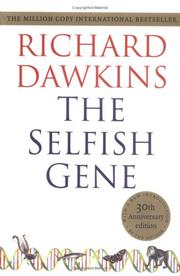
The Selfish Gene
The million copy international bestseller, critically acclaimed and translated into over 25 languages.
As influential today as when it was first published, The Selfish Gene has become a classic exposition of evolutionary thought. Professor Dawkins articulates a gene's eye view of evolution - a view giving centre stage to these persistent units of information, and in which organisms can be seen as vehicles for their replication. This imaginative, powerful, and stylistically brilliant work not only brought the insights of Neo-Darwinism to a wide audience, but galvanized the biology community, generating much debate and stimulating whole new areas of research. Forty years later, its insights remain as relevant today as on the day it was published.
This 40th anniversary edition includes a new epilogue from the author discussing the continuing relevance of these ideas in evolutionary biology today, as well as the original prefaces and foreword, and extracts from early reviews.
Oxford Landmark Science books are 'must-read' classics of modern science writing which have crystallized big ideas, and shaped the way we think.
As influential today as when it was first published, The Selfish Gene has become a classic exposition of evolutionary thought. Professor Dawkins articulates a gene's eye view of evolution - a view giving centre stage to these persistent units of information, and in which organisms can be seen as vehicles for their replication. This imaginative, powerful, and stylistically brilliant work not only brought the insights of Neo-Darwinism to a wide audience, but galvanized the biology community, generating much debate and stimulating whole new areas of research. Forty years later, its insights remain as relevant today as on the day it was published.
This 40th anniversary edition includes a new epilogue from the author discussing the continuing relevance of these ideas in evolutionary biology today, as well as the original prefaces and foreword, and extracts from early reviews.
Oxford Landmark Science books are 'must-read' classics of modern science writing which have crystallized big ideas, and shaped the way we think.
☰

Einstein: His Life and Universe
The definitive, internationally bestselling biography of Albert Einstein. Now the basis of Genius, the ten-part National Geographic series on the life of Albert Einstein, starring the Oscar, Emmy, and Tony Award–winning actor Geoffrey Rush as Einstein.
How did his mind work? What made him a genius? Isaacson’s biography shows how Einstein’s scientific imagination sprang from the rebellious nature of his personality. His fascinating story is a testament to the connection between creativity and freedom. Einstein explores how an imaginative, impertinent patent clerk—a struggling father in a difficult marriage who couldn’t get a teaching job or a doctorate—became the mind reader of the creator of the cosmos, the locksmith of the mysteries of the atom, and the universe. His success came from questioning conventional wisdom and marveling at mysteries that struck others as mundane. This led him to embrace a morality and politics based on respect for free minds, free spirits, and free individuals.
Einstein, the classic #1 New York Times bestseller, is a brilliantly acclaimed account of the most influential scientist of the twentieth century, “an illuminating delight” (The New York Times). The basis for the National Geographic series Genius, by the author of The Innovators, Steve Jobs, and Benjamin Franklin, this is the definitive biography of Albert Einstein.
How did his mind work? What made him a genius? Isaacson’s biography shows how Einstein’s scientific imagination sprang from the rebellious nature of his personality. His fascinating story is a testament to the connection between creativity and freedom. Einstein explores how an imaginative, impertinent patent clerk—a struggling father in a difficult marriage who couldn’t get a teaching job or a doctorate—became the mind reader of the creator of the cosmos, the locksmith of the mysteries of the atom, and the universe. His success came from questioning conventional wisdom and marveling at mysteries that struck others as mundane. This led him to embrace a morality and politics based on respect for free minds, free spirits, and free individuals.
Einstein, the classic #1 New York Times bestseller, is a brilliantly acclaimed account of the most influential scientist of the twentieth century, “an illuminating delight” (The New York Times). The basis for the National Geographic series Genius, by the author of The Innovators, Steve Jobs, and Benjamin Franklin, this is the definitive biography of Albert Einstein.
Science
☰
The Discoverers (Knowledge Series Book 2)
Knowledge #2
An original history of man's greatest adventure: his search to discover the world around him. In the compendious history, Boorstin not only traces man's insatiable need to know, but also the obstacles to discovery and the illusion that knowledge can also put in our way. Covering time, the earth and the seas, nature and society, he gathers and analyzes stories of the man's profound quest to understand his world and the cosmos.
☰
Models of My Life
The autobiography of an intellectual, this volume traces the dauntingly diverse career of a pioneer in artificial intelligence. Aside from his work in computer science, Simon has achieved important breakthroughs in political theory and cognitive psychology, and won the Nobel Prize for economics. He begins with his Wisconsin boyhood, sheds considerable light on the science and politics of academe, and clarifies how computers imitate human thought when devising innovative solutions to new problems. Comparing life to a maze, Simon defines the search for a path as the essential mental task of being human. ISBN 0-465-04640-1: $26.95.
☰

River Out of Eden: A Darwinian View of Life (Science Masters Series)
How did the replication bomb we call ”life” begin and where in the world, or rather, in the universe, is it heading? Writing with characteristic wit and an ability to clarify complex phenomena (the New York Times described his style as ”the sort of science writing that makes the reader feel like a genius”), Richard Dawkins confronts this ancient mystery.
☰
The Emperor of All Maladies: A Biography of Cancer
Selected as One of the Best Books of the 21st Century by The New York Times
Winner of the Pulitzer Prize, adapted as a documentary from Ken Burns on PBS, this New York Times bestseller is “an extraordinary achievement” (The New Yorker)—a magnificent, profoundly humane “biography” of cancer.
Physician, researcher, and award-winning science writer, Siddhartha Mukherjee examines cancer with a cellular biologist’s precision, a historian’s perspective, and a biographer’s passion. The result is an astonishingly lucid and eloquent chronicle of a disease humans have lived with—and perished from—for more than five thousand years.
The story of cancer is a story of human ingenuity, resilience, and perseverance, but also of hubris, paternalism, and misperception. Mukherjee recounts centuries of discoveries, setbacks, victories, and deaths, told through the eyes of his predecessors and peers, training their wits against an infinitely resourceful adversary that, just three decades ago, was thought to be easily vanquished in an all-out “war against cancer.” The book reads like a literary thriller with cancer as the protagonist.
Riveting, urgent, and surprising, The Emperor of All Maladies provides a fascinating glimpse into the future of cancer treatments. It is an illuminating book that provides hope and clarity to those seeking to demystify cancer.
Winner of the Pulitzer Prize, adapted as a documentary from Ken Burns on PBS, this New York Times bestseller is “an extraordinary achievement” (The New Yorker)—a magnificent, profoundly humane “biography” of cancer.
Physician, researcher, and award-winning science writer, Siddhartha Mukherjee examines cancer with a cellular biologist’s precision, a historian’s perspective, and a biographer’s passion. The result is an astonishingly lucid and eloquent chronicle of a disease humans have lived with—and perished from—for more than five thousand years.
The story of cancer is a story of human ingenuity, resilience, and perseverance, but also of hubris, paternalism, and misperception. Mukherjee recounts centuries of discoveries, setbacks, victories, and deaths, told through the eyes of his predecessors and peers, training their wits against an infinitely resourceful adversary that, just three decades ago, was thought to be easily vanquished in an all-out “war against cancer.” The book reads like a literary thriller with cancer as the protagonist.
Riveting, urgent, and surprising, The Emperor of All Maladies provides a fascinating glimpse into the future of cancer treatments. It is an illuminating book that provides hope and clarity to those seeking to demystify cancer.
☰

The Gene: An Intimate History
The #1 NEW YORK TIMES Bestseller
The basis for the PBS Ken Burns Documentary The Gene: An Intimate History
Now includes an excerpt from Siddhartha Mukherjee’s new book Song of the Cell!
From the Pulitzer Prize–winning author of The Emperor of All Maladies—a fascinating history of the gene and “a magisterial account of how human minds have laboriously, ingeniously picked apart what makes us tick” (Elle).
“Sid Mukherjee has the uncanny ability to bring together science, history, and the future in a way that is understandable and riveting, guiding us through both time and the mystery of life itself.” —Ken Burns
“Dr. Siddhartha Mukherjee dazzled readers with his Pulitzer Prize-winning The Emperor of All Maladies in 2010. That achievement was evidently just a warm-up for his virtuoso performance in The Gene: An Intimate History, in which he braids science, history, and memoir into an epic with all the range and biblical thunder of Paradise Lost” (The New York Times). In this biography Mukherjee brings to life the quest to understand human heredity and its surprising influence on our lives, personalities, identities, fates, and choices.
“Mukherjee expresses abstract intellectual ideas through emotional stories…[and] swaddles his medical rigor with rhapsodic tenderness, surprising vulnerability, and occasional flashes of pure poetry” (The Washington Post). Throughout, the story of Mukherjee’s own family—with its tragic and bewildering history of mental illness—reminds us of the questions that hang over our ability to translate the science of genetics from the laboratory to the real world. In riveting and dramatic prose, he describes the centuries of research and experimentation—from Aristotle and Pythagoras to Mendel and Darwin, from Boveri and Morgan to Crick, Watson and Franklin, all the way through the revolutionary twenty-first century innovators who mapped the human genome.
“A fascinating and often sobering history of how humans came to understand the roles of genes in making us who we are—and what our manipulation of those genes might mean for our future” (Milwaukee Journal-Sentinel), The Gene is the revelatory and magisterial history of a scientific idea coming to life, the most crucial science of our time, intimately explained by a master. “The Gene is a book we all should read” (USA TODAY).
The basis for the PBS Ken Burns Documentary The Gene: An Intimate History
Now includes an excerpt from Siddhartha Mukherjee’s new book Song of the Cell!
From the Pulitzer Prize–winning author of The Emperor of All Maladies—a fascinating history of the gene and “a magisterial account of how human minds have laboriously, ingeniously picked apart what makes us tick” (Elle).
“Sid Mukherjee has the uncanny ability to bring together science, history, and the future in a way that is understandable and riveting, guiding us through both time and the mystery of life itself.” —Ken Burns
“Dr. Siddhartha Mukherjee dazzled readers with his Pulitzer Prize-winning The Emperor of All Maladies in 2010. That achievement was evidently just a warm-up for his virtuoso performance in The Gene: An Intimate History, in which he braids science, history, and memoir into an epic with all the range and biblical thunder of Paradise Lost” (The New York Times). In this biography Mukherjee brings to life the quest to understand human heredity and its surprising influence on our lives, personalities, identities, fates, and choices.
“Mukherjee expresses abstract intellectual ideas through emotional stories…[and] swaddles his medical rigor with rhapsodic tenderness, surprising vulnerability, and occasional flashes of pure poetry” (The Washington Post). Throughout, the story of Mukherjee’s own family—with its tragic and bewildering history of mental illness—reminds us of the questions that hang over our ability to translate the science of genetics from the laboratory to the real world. In riveting and dramatic prose, he describes the centuries of research and experimentation—from Aristotle and Pythagoras to Mendel and Darwin, from Boveri and Morgan to Crick, Watson and Franklin, all the way through the revolutionary twenty-first century innovators who mapped the human genome.
“A fascinating and often sobering history of how humans came to understand the roles of genes in making us who we are—and what our manipulation of those genes might mean for our future” (Milwaukee Journal-Sentinel), The Gene is the revelatory and magisterial history of a scientific idea coming to life, the most crucial science of our time, intimately explained by a master. “The Gene is a book we all should read” (USA TODAY).
☰
Genome: The Autobiography of a Species in 23 Chapters
The genome's been mapped.But what does it mean? Arguably the most significant scientific discovery of the new century, the mapping of the twenty-three pairs of chromosomes that make up the human genome raises almost as many questions as it answers. Questions that will profoundly impact the way we think about disease, about longevity, and about free will. Questions that will affect the rest of your life. Genome offers extraordinary insight into the ramifications of this incredible breakthrough. By picking one newly discovered gene from each pair of chromosomes and telling its story, Matt Ridley recounts the history of our species and its ancestors from the dawn of life to the brink of future medicine. From Huntington's disease to cancer, from the applications of gene therapy to the horrors of eugenics, Matt Ridley probes the scientific, philosophical, and moral issues arising as a result of the mapping of the genome. It will help you understand what this scientific milestone means for you, for your children, and for humankind.
Recommend a 'Genius Quest' Book
Thanks for the recommendation!