Book Club

Named one of the best books of the year by The Wall Street Journal, The New York Times Book Review, The Washington Post, Time, The Economist, New York Post, and Town & Country • One of Barack Obama’s Favorite Books of the Year • Named finalist for the PEN Literary Awards
“With tenacity and candor, Haidt lays out the consequences that have come with allowing kids to drift further into the virtual world . . . While also offering suggestions and solutions that could help protect a new generation of kids.” —Time
After more than a decade of stability or improvement, the mental health of adolescents plunged in the early 2010s. Rates of depression, anxiety, self-harm, and suicide rose sharply, more than doubling on many measures. Why?
In The Anxious Generation, social psychologist Jonathan Haidt (pronounced "height") lays out the facts about the epidemic of teen mental illness that hit many countries at the same time. He then investigates the nature of childhood, including why children need play and independent exploration to mature into competent, thriving adults. Haidt shows how the “play-based childhood” began to decline in the 1980s, and how it was finally wiped out by the arrival of the “phone-based childhood” in the early 2010s. He presents more than a dozen mechanisms by which this “great rewiring of childhood” has interfered with children’s social and neurological development, covering everything from sleep deprivation to attention fragmentation, addiction, loneliness, social contagion, social comparison, and perfectionism. He explains why social media damages girls more than boys and why boys have been withdrawing from the real world into the virtual world, with disastrous consequences for themselves, their families, and their societies.
Most important, Haidt issues a clear call to action. He diagnoses the “collective action problems” that trap us, and then proposes four simple rules that might set us free. He describes steps that parents, teachers, schools, tech companies, and governments can take to end the epidemic of mental illness and restore a more humane childhood.
Haidt has spent his career speaking truth backed by data in the most difficult landscapes—communities polarized by politics and religion, campuses battling culture wars, and now the public health emergency faced by Gen Z. We cannot afford to ignore his findings about protecting our children—and ourselves—from the psychological damage of a phone-based life.
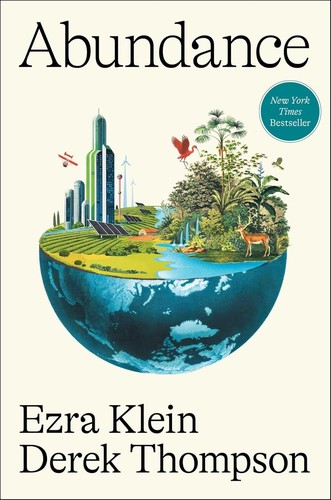
“A must-read for progressives who want a blueprint for reforming government so it can deliver for working people.” —Barack Obama • “A terrific book...Powerful and persuasive.” —Fareed Zakaria • “Spectacular…Offers a comprehensive indictment of the current problems and a clear path forward…Klein and Thompson usher in a mood shift. They inspire hope and enlarge the imagination.” —David Brooks, The New York Times
From bestselling authors and journalistic titans Ezra Klein and Derek Thompson, Abundance is a once-in-a-generation, paradigm-shifting call to renew a politics of plenty, face up to the failures of liberal governance, and abandon the chosen scarcities that have deformed American life.
To trace the history of the twenty-first century so far is to trace a history of unaffordability and shortage. After years of refusing to build sufficient housing, America has a national housing crisis. After years of limiting immigration, we don’t have enough workers. Despite decades of being warned about the consequences of climate change, we haven’t built anything close to the clean-energy infrastructure we need. Ambitious public projects are finished late and over budget—if they are ever finished at all. The crisis that’s clicking into focus now has been building for decades—because we haven’t been building enough.
Abundance explains that our problems today are not the results of yesteryear’s villains. Rather, one generation’s solutions have become the next generation’s problems. Rules and regulations designed to solve the problems of the 1970s often prevent urban-density and green-energy projects that would help solve the problems of the 2020s. Laws meant to ensure that government considers the consequences of its actions have made it too difficult for government to act consequentially. In the last few decades, our capacity to see problems has sharpened while our ability to solve them has diminished.
Progress requires facing up to the institutions in life that are not working as they need to. It means, for liberals, recognizing when the government is failing. It means, for conservatives, recognizing when the government is needed. In a book exploring how we can move from a liberalism that not only protects and preserves but also builds, Klein and Thompson trace the political, economic, and cultural barriers to progress and propose a path toward a politics of abundance. At a time when movements of scarcity are gaining power in country after country, this is an answer that meets the challenges of the moment while grappling honestly with the fury so many rightfully feel.
#1 New York Times Bestseller
In Being Mortal, bestselling author Atul Gawande tackles the hardest challenge of his profession: how medicine can not only improve life but also the process of its ending
Medicine has triumphed in modern times, transforming birth, injury, and infectious disease from harrowing to manageable. But in the inevitable condition of aging and death, the goals of medicine seem too frequently to run counter to the interest of the human spirit. Nursing homes, preoccupied with safety, pin patients into railed beds and wheelchairs. Hospitals isolate the dying, checking for vital signs long after the goals of cure have become moot. Doctors, committed to extending life, continue to carry out devastating procedures that in the end extend suffering.
Gawande, a practicing surgeon, addresses his profession's ultimate limitation, arguing that quality of life is the desired goal for patients and families. Gawande offers examples of freer, more socially fulfilling models for assisting the infirm and dependent elderly, and he explores the varieties of hospice care to demonstrate that a person's last weeks or months may be rich and dignified.
Full of eye-opening research and riveting storytelling, Being Mortal asserts that medicine can comfort and enhance our experience even to the end, providing not only a good life but also a good end.
"Concise and elegant. . . . Rauch applies careful research and incisive prose to examine, diagnose, and prescribe a cure for the maladies afflicting contemporary religious-political dynamics."--Michael M. Rosen, Commentary
What happens to American democracy if Christianity is no longer able, or no longer willing, to perform the functions on which our constitutional order depends? In this provocative book, the award-winning journalist Jonathan Rauch--a lifelong atheist--reckons candidly with both the shortcomings of secularism and the corrosion of Christianity.
Thin Christianity, as Rauch calls the mainline church, has been unable to inspire and retain believers. Worse, a Church of Fear has distorted white evangelicalism in ways that violate the tenets of both Jesus and James Madison. What to do? For answers, Rauch looks to a new generation of religious thinkers, as well as to the Church of Jesus Christ of Latter-day Saints, which has placed the Constitution at the heart of its spiritual teachings.
In this timely critique Rauch addresses secular Americans who think Christianity can be abandoned, and Christian Americans who blame secular culture for their grievances. The two must work together, he argues, to confront our present crisis. He calls on Christians to recommit to the teachings of their faith that align with Madison, not MAGA, and to understand that liberal democracy, far from being oppressive, is uniquely protective of religious freedom. At the same time, he calls on secular liberals to understand that healthy religious institutions are crucial to the survival of the liberal state.

'Ground-breaking. Everyone should read this book' Bessel van der Kolk, author of The Body Keeps the Score
When it comes to understanding the connection between our mental and physical health, we should be looking at the exceptions, not the rules.
Dr Jeff Rediger, a world-leading Harvard psychiatrist, has spent the last fifteen years studying thousands of individuals from around the world, examining the stories behind extraordinary cases of recovery from terminal illness.
Observing the common denominators of people who have beaten the odds, Dr Rediger reveals the immense power of our immune system and unlocks the secrets of the mind-body connection. In Cured, he explains the vital role that nutrition plays in boosting our immunity and fighting off disease, and he also outlines how stress, trauma and identity affect our physical health.
In analysing the remarkable science of recovery, Dr Rediger reveals the power of our mind to heal our body and shows us the keys to good health.
'In an era of incurable chronic diseases causing 60% of all deaths worldwide, this book provides one potential way out' Dr Mark Hyman, author of The Blood Sugar Solution
'Seasoned with the author's penetrating insights about healing, clearly articulated science and illuminating case histories, Cured opens genuine vistas of transforming illness into health' Gabor Maté, author of When the Body Says No
“What an incredibly thorough documentation of the causes of the immigration crisis, the discussions that have been going on through multiple administrations.” —Jon Stewart, The Daily Show
“Everyone Who Is Gone Is Here is sure to take its place as one of the definitive accounts of the U.S. and Central American immigration puzzle. . . . Hopefully, those with the power to change things will listen.” —Manuel Roig-Franzia, Washington Post
An epic, heartbreaking, and deeply reported history of the disastrous humanitarian crisis at the southern border told through the lives of the migrants forced to risk everything and the policymakers who determine their fate, by New Yorker staff writer Jonathan Blitzer
Everyone who makes the journey faces an impossible choice. Hundreds of thousands of people who arrive every year at the US-Mexico border travel far from their homes. For years, the majority came from El Salvador, Guatemala, and Honduras, but many more have begun their journey much farther away. Some flee persecution, others crime or hunger. They may have already been deported, but the United States remains their only hope for safety and prosperity. They will take their chances.
As Jonathan Blitzer dramatizes with forensic, unprecedented reporting, this crisis is the result of decades of misguided policy and sweeping corruption. Brilliantly weaving the stories of Central Americans whose lives have been devastated by chronic political conflict and violence with those of American activists, government officials, and the politicians responsible for the country’s tragically tangled immigration policy, Blitzer reveals the full, layered picture of this vast and unremitting conflict.
Everyone Who Is Gone Is Here tells the epic story of the people whose lives ebb and flow across the border, delving into the heart of American life itself. This vital and remarkable story has shaped the nation’s turbulent politics and culture in countless ways—and will almost certainly determine its future.
“Expert storytelling . . . [Pollan] masterfully elevates a series of big questions about drugs, plants and humans that are likely to leave readers thinking in new ways.” —New York Times Book Review
From #1 New York Times bestselling author Michael Pollan, a radical challenge to how we think about drugs, and an exploration into the powerful human attraction to psychoactive plants—and the equally powerful taboos.
Of all the things humans rely on plants for—sustenance, beauty, medicine, fragrance, flavor, fiber—surely the most curious is our use of them to change consciousness: to stimulate or calm, fiddle with or completely alter, the qualities of our mental experience. Take coffee and tea: People around the world rely on caffeine to sharpen their minds. But we do not usually think of caffeine as a drug, or our daily use as an addiction, because it is legal and socially acceptable. So, then, what is a “drug”? And why, for example, is making tea from the leaves of a tea plant acceptable, but making tea from a seed head of an opium poppy a federal crime?
In This Is Your Mind on Plants, Michael Pollan dives deep into three plant drugs—opium, caffeine, and mescaline—and throws the fundamental strangeness, and arbitrariness, of our thinking about them into sharp relief. Exploring and participating in the cultures that have grown up around these drugs while consuming (or, in the case of caffeine, trying not to consume) them, Pollan reckons with the powerful human attraction to psychoactive plants. Why do we go to such great lengths to seek these shifts in consciousness, and then why do we fence that universal desire with laws and customs and fraught feelings?
In this unique blend of history, science, and memoir, as well as participatory journalism, Pollan examines and experiences these plants from several very different angles and contexts, and shines a fresh light on a subject that is all too often treated reductively—as a drug, whether licit or illicit. But that is one of the least interesting things you can say about these plants, Pollan shows, for when we take them into our bodies and let them change our minds, we are engaging with nature in one of the most profound ways we can. Based in part on an essay published almost twenty-five years ago, this groundbreaking and singular consideration of psychoactive plants, and our attraction to them through time, holds up a mirror to our fundamental human needs and aspirations, the operations of our minds, and our entanglement with the natural world.
“O’Neil reminds us that we must resist the urge to judge, belittle, and oversimplify, and instead allow always for complexity and lead always with empathy.”—Dave Eggers, author of The Every
ONE OF THE BEST BOOKS OF THE YEAR: The Times (UK)
Shame is a powerful and sometimes useful tool: When we publicly shame corrupt politicians, abusive celebrities, or predatory corporations, we reinforce values of fairness and justice. But as Cathy O’Neil argues in this revelatory book, shaming has taken a new and dangerous turn. It is increasingly being weaponized—used as a way to shift responsibility for social problems from institutions to individuals. Shaming children for not being able to afford school lunches or adults for not being able to find work lets us off the hook as a society. After all, why pay higher taxes to fund programs for people who are fundamentally unworthy?
O’Neil explores the machinery behind all this shame, showing how governments, corporations, and the healthcare system capitalize on it. There are damning stories of rehab clinics, reentry programs, drug and diet companies, and social media platforms—all of which profit from “punching down” on the vulnerable. Woven throughout The Shame Machine is the story of O’Neil’s own struggle with body image and her recent weight-loss surgery, which awakened her to the systematic shaming of fat people seeking medical care.
With clarity and nuance, O’Neil dissects the relationship between shame and power. Whom does the system serve? Is it counter-productive to call out racists, misogynists, and vaccine skeptics? If so, when should someone be “canceled”? How do current incentive structures perpetuate the shaming cycle? And, most important, how can we all fight back?